Posts

Love at First Sight by Wislawa Szymborska

<3 <3 <3 Focus. They're both convinced Meaning perhaps what they're convinced about is wrong That a sudden passion joined them. Self-explanatory - saw her/him needed her/him loved her/him Such certainty is beautiful But uncertainty is more beautiful still. This uncertainty is what the whole poem is about, as we shall see: Since they'd never met before, they're sure that there'd been nothing between them. The two lovers are under the impression that in their whole loves, they have never once met before, and so could not have had any kind of association or relationship with each other. But what's the word from the streets, staircases, hallways - perhaps they've passed each other by a million times? Now Wislawa points out that they could have met a million times and not known it - on the streets, staircases, hallways. I want to ask them if they don't remember - a moment face to face in some revolving door? perhaps a 'sorr...
A Scientific Religion by V. Raghunathan

About the author: 1.  http://www.thehindu.com/books/a-simple-book-of-reason/article3466719.ece 2.  http://www.vraghunathan.com/home.html To begin with, this guy is awesome. He's dabbled in and mastered such varied fields as banking, CSR, academics and is a prolific writer, having recently authored the book, 'Ganesha on the Dashboard' the link for which is above. The conclusion we need to draw from the essay is that we must have a rational, questioning but not skeptical approach to the issue of religion, rituals, God and faith. Raghunath discusses scientific temper and religion, scientific temper in everyday life, how to develop scientific temper, the convergence of religions, the responsibility of ushering in scientific temper, and proposes a more evolved religion. In the section ' Marrying Religion with Scientific Temper ' the author wonders whether it is possible for religion, based on faith, to be consistent with science, based on reason. Either way, ...

General English General Tips

:P Okay, let's begin with the portion: POETRY: Requisites: context - content - form (format of answering questions) Notes 1. My Grandmother's House (Kamala Das) http://www.projectcctvnotes.blogspot.in/2014/06/notes-on-my-grandmothers-house-by.html 2. Love at First Sight (Wislawa Szymborska) http://www.projectcctvnotes.blogspot.in/2014/09/notes-on-love-at-first-sight-by-wislawa.html PROSE: Requisites: Patience Common sense Notes Ability to answer questions after text 3. Lajwanti (Rajinder Singh Bedi) http://www.projectcctvnotes.blogspot.in/2014/08/notes-lajwanti-by-rajinder-singh-bedi.html 4. Childhood (Ismat Chugtai) 5. Umpiring! (Moti Nandy) 6. South Indian Filter Coffee with Amma (Julie Sahni) (even the title is so long) http://www.projectcctvnotes.blogspot.in/2014/08/notes-south-indian-filter-coffee-with.html 7. A Scientific Religion (V. Raghunathan) http://www.projectcctvnotes.blogspot.in/2014/09/notes-on-scientific-religion-by-v.html SELF-LEARN...

An Indentured Spirit by some Tejasvi

1. Comment on the title of the essay. 2. Write a charactersketch of Maara. 3. Discuss the relationship between man and nature, as in the narrative, "An Indentured Spirit." 4. Discuss the relationship between the author and Maara. 5. How does the wordly-wise Maara outwit the intellectually superior narrator? What does it tell you about life and living? 6. Comment on Maara's superstitions and faith, and how it works to the advantage of the narrator. So let's begin with the character sketch, shall we? Elaborate on the points I'm listing below: aged, reluctant assumes accusatin of theft, defends himself using irrelevant points like "won't fit me" very bitter about puppy - ruined his sleep lazy old mn - weary old man too old to be tempted to steal leisurely soul believer: birth-rebirth cycle very "worldly wise" "extraordinary intelligence lurked beneath the cover of idiocy" very nice line: "didn't see much d...

South Indian Filter Coffee with Amma by Julie Sahni

This chapter of our textbook appears to be written for non-Indian people, as we see when the authors writes the English version of the word before the Hindi one, as in "elixir 'amrita'", "creamy pudding kheer", "jaggery gur", "mother, Amma" and the unfunny joke: "form an asana (in my language it means twist into a pretzel!)" She tries too hard to get the reader to relate to the magic of the milk-related memories of her childhood, and her attachment to her mother, but for reasons I can't place my finger on, fails, and fails miserably at that - succeeding only in getting us mildly irritated. Perhaps it is the pretentious Nigella tone of the text, or the occasional lapses in meaningful sentence-formation: "She just isn't fond of it, but obsessed with it." Also, there is the issue of her over-zealous description of everything. One question that caught my attention: Examine the interconnected themes of memo...

Lajwanti by Rajinder Singh Bedi

Here is my write-up (assignment) (imperfect) (scored 15 on 20) (done for the sake of doing it) (many apologies) : The chapter Lajwanti by Rajinder Singh Bedi is set in the wake of the India-Pakistan Partition – specifically, the abduction of women on either side of the border. During the Partition, tens of thousands of Hindus and Muslims were forced to pack and leave, because suddenly, allegiance to one’s country was based on religion. Families who had been living on the “wrong” side of the border since generations had to migrate, at moment’s notice, to their “homeland”. In the midst of all this pain, anguish, separation and large-scale identity crises, displaced people began attacking the “enemies” – through thefts, violence and abductions, as was the case with the protagonist Sunder Lal, and his wife Lajwanti, who was abducted. In brief, the story Lajwanti is as such: Sunder Lal, after losing his wife Lajwanti to abductors, and abandoning all hope of finding her again, pu...

Notes on My Grandmother's House by Kamala Das

Image
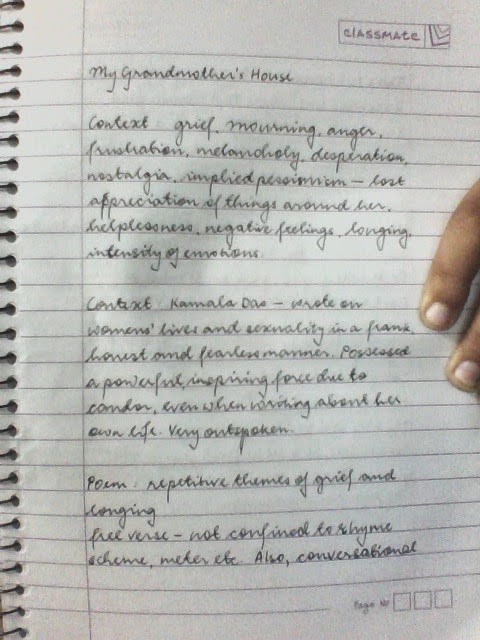
The poem My Grandmother's House has taken many, many classes, with varying levels of productivity, to complete. To begin with, there was a brief discussion about the poet herself - her life, background, style etc. In the next class, to "set the mood," we shared our memories of our grandparents, and the lessons we've learnt from them. In the last class, owing to the fact that not everyone had their textbooks, Sir briefly discussed (again) the poet, and the poem. There was a depressing reading-out in class, as well. Now for the notes. free verse house changed by death of grandmother: "The house withdrew into silence, snakes moved among books" "blind eyes of windows" = nobody inside? "frozen air" "Darkness" Author changed by death of grandmother: "my blood turned cold like the moon" Otherwise change in author: "once/ I received love" "was proud, and loved" "... I ...

First post!!!

Whoop dee doo! Anyway, Prof. Daniel came up with the idea of uploading the class notes on a blog, so here it is. If you need any clarifications related to what I've posted, feel free to ask me, I'll respond within a day or two. However, note that this is a Project CCTV blog, which implies that I am only reporting what goes on, so to say... Ask Prof. Daniel your doubts. This is not a forum for discussion. Do not argue in the comments, do that in class. Love, M.