Posts

Showing posts with the label summary

Graduation by Maya Angelou

Graduation How do the students prepare for the ceremony? Bring out the excitement in the tone of narration. How does the wait for the event turn out to be a disappointment? What are some of the striking features of this narrative that make it autobiographical? What is the significance of the speakers and the impact of their speech on the young girl? Compare and contrast both the speakers mentioned in the story. "Maya Angelou’s “Graduation” is the story of Marguerite Johnson’s eighth grade graduation, but the events of the story and Marguerite’s reactions to them also suggest Marguerite’s personal growth in terms of her understanding of herself and others." " Maya Angelou   describes in her essay “ Graduation ” an abrupt shift in identity that she experienced. During her 8th grade commencement ceremony, she became painfully aware of the prejudice and stereotypes that haunt her race. She also realized the history of this behavior and the obstacles that she faces ...
Color by Dorothea Mackellar

The speaker recalls with adoration <adulation?> the lovely things she has watched that have unwittingly seeped  her soul in color with every passing day. Stanza 2: saffron sunset clouds larkspur ( meaning ) mountains* fenceless miles of plain* (fields, prairies) golden-green hillsides*, shining unearthly after rain Stanza 3: nights of blue and pearl simile - long smooth beaches yellow as sunburnt wheat others - line of foam that creams and hisses, enticing weary feet  (transferred epithet) Stanza 4: emeralds sunset-hearted opals Asian marble veined with scarlet flame cool green jade misty and azure-stained moonstones Stanza 5: almond trees in bloom oleanders* wide purple sea of plain-land (meaning field) gorgeous with a lovely poison - the evil Darling pea* She calls on these images to help her dream when she is tired, like how in stanza 6, lemon, pink, or faintest, coolest lilac dawn-lit skies float on her soothed eyes. No n...

South Indian Filter Coffee with Amma by Julie Sahni

This chapter of our textbook appears to be written for non-Indian people, as we see when the authors writes the English version of the word before the Hindi one, as in "elixir 'amrita'", "creamy pudding kheer", "jaggery gur", "mother, Amma" and the unfunny joke: "form an asana (in my language it means twist into a pretzel!)" She tries too hard to get the reader to relate to the magic of the milk-related memories of her childhood, and her attachment to her mother, but for reasons I can't place my finger on, fails, and fails miserably at that - succeeding only in getting us mildly irritated. Perhaps it is the pretentious Nigella tone of the text, or the occasional lapses in meaningful sentence-formation: "She just isn't fond of it, but obsessed with it." Also, there is the issue of her over-zealous description of everything. One question that caught my attention: Examine the interconnected themes of memo...

Lajwanti by Rajinder Singh Bedi

Here is my write-up (assignment) (imperfect) (scored 15 on 20) (done for the sake of doing it) (many apologies) : The chapter Lajwanti by Rajinder Singh Bedi is set in the wake of the India-Pakistan Partition – specifically, the abduction of women on either side of the border. During the Partition, tens of thousands of Hindus and Muslims were forced to pack and leave, because suddenly, allegiance to one’s country was based on religion. Families who had been living on the “wrong” side of the border since generations had to migrate, at moment’s notice, to their “homeland”. In the midst of all this pain, anguish, separation and large-scale identity crises, displaced people began attacking the “enemies” – through thefts, violence and abductions, as was the case with the protagonist Sunder Lal, and his wife Lajwanti, who was abducted. In brief, the story Lajwanti is as such: Sunder Lal, after losing his wife Lajwanti to abductors, and abandoning all hope of finding her again, pu...

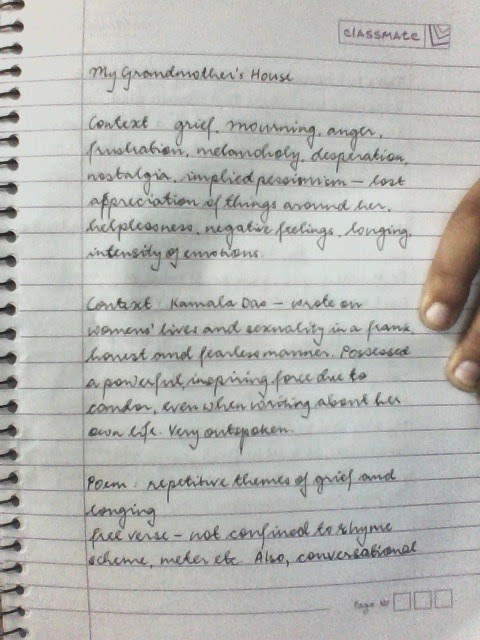
Notes on My Grandmother's House by Kamala Das

Image
The poem My Grandmother's House has taken many, many classes, with varying levels of productivity, to complete. To begin with, there was a brief discussion about the poet herself - her life, background, style etc. In the next class, to "set the mood," we shared our memories of our grandparents, and the lessons we've learnt from them. In the last class, owing to the fact that not everyone had their textbooks, Sir briefly discussed (again) the poet, and the poem. There was a depressing reading-out in class, as well. Now for the notes. free verse house changed by death of grandmother: "The house withdrew into silence, snakes moved among books" "blind eyes of windows" = nobody inside? "frozen air" "Darkness" Author changed by death of grandmother: "my blood turned cold like the moon" Otherwise change in author: "once/ I received love" "was proud, and loved" "... I ...